
Very Brief History
Giacomo di Grassi was a 16th century fencing master. Di Grassi travelled around Italy observing the various teachings of schools and masters. From this, he developed his ideas about what was good and what was unnecessary to form his own style, penned in his treatise Discourse on Wielding Arms with Safety (lit Ragione di adoprar sicuramente l’Arme) 1570. A new edition of his brook was printed in London, The True Art of Defence, (lit DiGraſsi his true Arte of Defence), organised by an admirer named Thomas Churchyard.
Giacomo di Grassi His True Art of Defense, plainly teaching by infallible Demonstrations, apt Figures and perfect Rules the manner and form how a man without other Teacher or Master may handle all sorts of Weapons as well offensive as defensive: With a Treatise Of Deceit or Falsing: And with a way or Means by private Industry to obtain Strength, Judgement, and Activity
First written in Italian by the Fore-said Author, And Englished by I. G. gentleman.
It is recognised the while the English adaptation is referred to as an updated copy, not all of the original Italian concepts translated well. Wiktenauer, an only collaborative Wiktionary that works to translate period European treatise into modern language, lists both the original English by I G Gentleman, the Archetype (1570) [edit] Transcribed by Kelly Hatcher from the original Italian, and Incomplete Modernization Unfinished translation by Norman White.
The True Art of Defence
Di Grassi had two major sections of his treatise. The first section is The True Art, which is what you would want to use in a fight with someone who knew the fine art of sword craft. This is a distillation of what di Grassi learned in his travels and is a set of heuristics for how to strike your opponent, how to avoid your opponent, how to defend against your opponent and the better movements to make.
Di Grassi’s second section is on The False Art, which is fun tricks that might work if your opponent hasn’t seen them, or against people of lesser skill. Do not use these tricks if you are in a real fight and you value your life.
Basic Principles
First, that the right or straight Line is of all other the shortest: wherefore if a man would strike in the shortest line, it is requisite that he strike in the straight line.”
Secondly, he that is nearest, hits soonest. Out of which advertisement a man may reap this profit, that seeing the enemies sword far off, aloft and ready to strike, he may first strike the enemy, before he himself be struck.
Thirdly, a Circle that goes compassing bears more force in the extremity of the circumference, than in the center thereof.
Fourthly, a man may more easily withstand a small than a great force.
Fifthly, every motion is accomplished in time.
Prioritise the Thrust
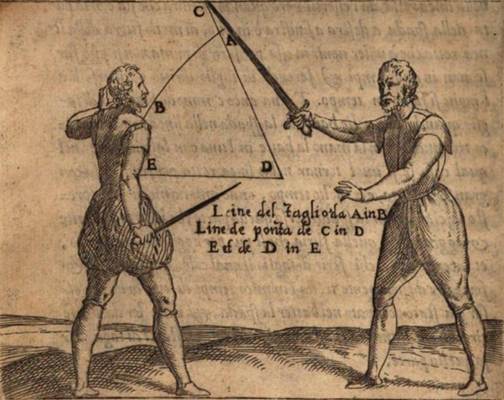
…all edge blows, be they right or reversed, frame either a circle or part of a circle: of the which the hand is the Centre, and the length of the sword, the Diameter.
That is, cuts are curved by nature and thus are slower than a thrust.
Whereupon he that would give either an edge blow in a great compass, either thrust with the point of the sword, must not only be nimble of hand, but also must observe the time of advantage, which is, to know when his own sword is more near and ready to strike than his enemy’s.
That is, respond to a cut with a thrust, but only if you have the right time, if you have the accuracy, and if you can make the thrust in time.
Concerning thrusting, or the most perilous blows of the point, he must provide so to stand with his body, feet and arms, that he be not forced, when he would strike, to lose time: The which he shall do, if he stand either with his arm so forward, either with his feet so backward, either with his body so disorderly, that before he thrust he must needs draw back his arm, help himself with his feet, or use some dangerous motion of the body, the which when the enemy perceives, he may first strike before he be struck.
That is, if you are forced into a thrust to succeed, then perhaps you have not got the advantage, if your range is poor, footing is poor or ward is poor.
Di Grassi discusses body mechanics and how we use circular motions to make straight lines.
Without all doubt, the thrust is to be preferred before the edge-blow, as well because it strikes in less time, as also for that in the said time, it does more hurt. For which consideration, the Romans (who were victorious in all enterprises) did accustom their soldiers of the Legions to thrust only: Alleging for their reason, that the blows of the edge, though they were great, yet they are very few that are deadly, and that thrusts, though little and weak, when they enter but iii fingers into the body, are wont to kill. Therefore, I lay down this for a firm and certain rule, that the thrust does many times more readily strike, and give the greater blow against the enemy. And to the end, a man may thrust it out with the greatest force at the most advantage, and uttermost length that may be, he must always remember to carry his left foot compassing behind him in such sort, that the hindfoot so compassing may always be in the straight line of the hand and sword, as a Diameter in the midst of a Circle. And in finishing of a blow, to draw his hindfoot a half pace forwards, and so by that means the blow is longer and stronger, and shoulder and side are only opposite to the enemy, and so far from him, that they may not be struck: and it is not possible for a man to frame a longer blow than this.
Use the Cut only when needed
the edge differs from the point, in that being out of the straight line, it endeavours to come into the same again. Therefore when it happens the point to be borne either on the right, either on the left side, either aloft, out of the straight line, if then one would thrust in the right line, he cannot perform it but in two times, whereas if he would strike with the edge be it right or reversed, or downwards, he may do it in one time. It shall be also very commodious rather to strike with the edge, when as sometime a man bearing his sword in the straight line, and the enemy there finding it, does with his hand beat it on this side or that side. In which case, if he would return it again into the said line of purpose to strike, he shall be constrained to do it with great violence and much time.
That is, if your arm is somewhat straight, and your tip is out of the line of the thrust, return it to the line with a cut
Wards
Wards in weapons are such sites, positions or placings which withstand the enemy’s blows, and are as a shield or safeguard against them.
The High Ward
… by turning the point of the sword downward, it wards the whole person, and for that, by gathering in of the hindfoot, and increasing forwards with the right foot, a man may discharge a strong thrust above hand at his enemy.
Di Grassi recommends that you should hold your tip such that you can aim for a thrust to the head or upper body.
Di Grassi warns to be mindful for your tip:
- To not rise higher than your opponents head, else they will duck under your tip and strike you.
- To not dip to low, else they will beat your sword downward and come into strike.
The Broad Ward
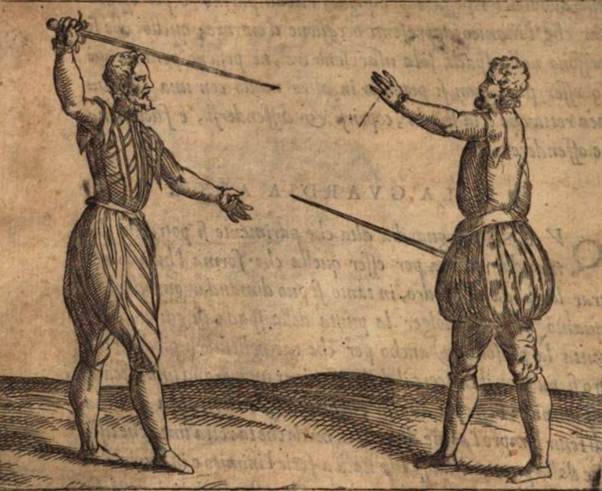
because the Arm widening and stretching itself directly as much as possible from the right side, bears the sword so far off from the body, that it seems to give great scope to the enemy to enter, albeit in truth it be nothing so. For although the hand and the handle of the sword, be both far from the body, and quite out of the straight line, yet the point of the sword, from which principally proceeds the offense, is not without the said line…
di Grassi warns:
- If the tip is to far across your body, you deny your opponent the invitation, or they may neat your blade, enter your range and strike you
- If the tip is to far from the line (outwards), then they will do the same, or step in and across (traversal step) and thrust at you
The Low Ward
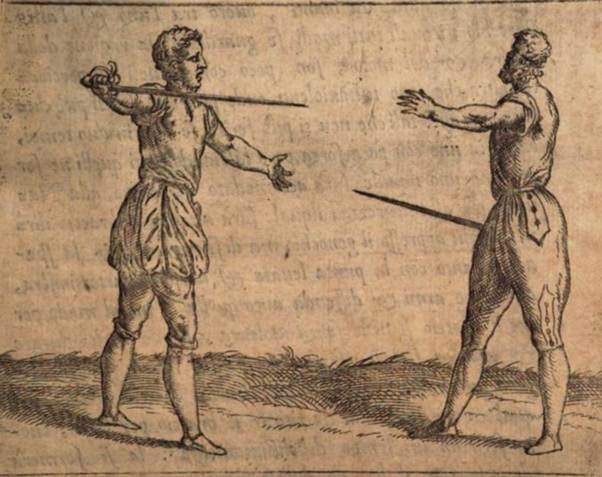
one bears his arm directly downwards near his knee (but yet without it) and his sword with his point somewhat raised, and bearing towards the left side, to the end, it may arm and defend that part also, in such sort, that (being borne without violence) he may continue long.
And if he would strike, he may in one time, forcibly deliver a great thrust.
Di Grassi warns:
- If you extend your arm outwards (such as the Spaniards), then you cannot thrust without having to draw it back first, which is slower; or your thrust will be very weak
Here “violence” means to rise your sword up against gravity (down is natural, up is violence).
When di Grassi says “but yet without it”, he means slightly on the outside of your knee, not literally above it.
The means to defend
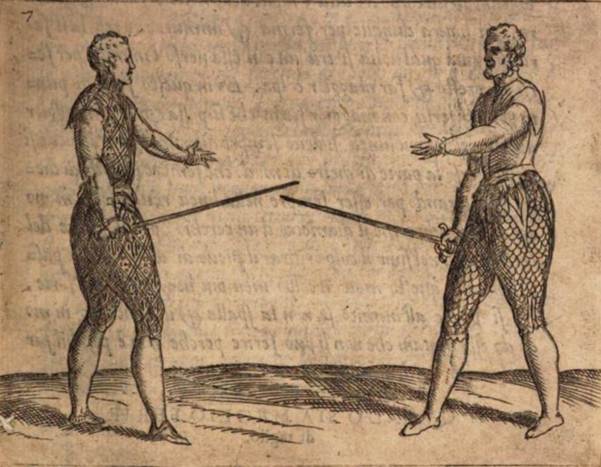
There are 4 methods of defending
- …the weapon is opposed to the blow, in such sort that the weapon which comes striking either at the head or at the body, cannot hit home to the place whereunto it is directed, but hindered by some thing or other then set against it, be it sword, dagger, target, bill, javelin, or anything else, which at that instant a man has in his hand.
That is, block it with the edge
- First, by withdrawing of themselves, they encounter the enemy’s sword towards the point, in which place it bears most force, and therefore with great difficulty they sustain the blow.
Di Grassi warns that retreating directly backward sets you up in a weaker position, but is valid
- Another is, if they would strike the enemy, of force they must return their feet and weapons thither, where they were before, and yet increase forwards somewhat more, if they would strongly strike him: And in this they spend so much time, that the enemy may not only easily defend, but also, very well and safely strike.
That is, advance into your enemy, striking at the enemy or their sword strongly
- the body voids out of the straight line towards this or that side, but this is seldom used alone and by itself, but rather accompanied with the opposing of the weapon, or with the second manner of defence aforesaid. If it be used alone, the manner is to slip the blow, and to strike the enemy in the same time that he is overreached in his blow.
That is, sidestep, ideally with an advancing sidestep and attack.
The Exercise: Breaking down some passes
The following example builds up some move, counter moves from a single starting point.
- Pass 1 shows a build-up of moves.
- Pass 2 shows some variants of
Pass 1
- Person A: With a straight pace of the right foot, thrust from high ward under opponent’s sword/s toward their pelvis.
- Person B: does nothing, they die
- Person A: With a straight pace of the right foot, thrust from high ward under opponent’s sword/s toward their pelvis.
- Person B: voids or blocks
- Person A: cut an edge-blow from the wrist from right to left at the opponent’s head, using a compass step of the left foot.
- Person A: With a straight pace of the right foot, thrust from high ward under opponent’s sword/s toward their pelvis.
- Person B: voids or blocks
- Person A: cut an edge-blow from the wrist from right to left at the opponent’s head, using a compass step of the left foot.
- Person B: defends or voids again
- Person A: advances a slope pace with the left foot, deliver a left-to-right (reverse) cut from the elbow.
- Person A: Return to low ward and deliver another thrust underneath opponent’s swords, gathering left foot and advancing with right foot.
Pass 2
Two variants of the above
- Person A: With a straight pace of the right foot, thrust from high ward under opponent’s sword/s toward their pelvis.
- Person B: Defend the thrust from high ward with the sword, taking a slope pace of the left foot then a straight pace of the right foot.
- Person A: With a straight pace of the right foot, thrust from high ward under opponent’s sword/s toward their pelvis.
- Person B: voids or blocks (as in Pass 1, second variant)
- Person A: cut an edge-blow from the wrist from right to left at the opponent’s head, using a compass step of the left foot.
- Person B: Counter the cut with your sword and thrust at opponent’s face with a compass step.
- Person A: Counter the reverse cut with a compass step and a cut towards opponent’s head.