
From the first point in time one of our ancient ancestors picked up a stick to extend their arm, or picked up a stone to throw at something, the range of attack and defense of individuals was extended beyond the furtherest reach of our finger tips. Even so, there is a large philosophical difference between how you use a sword or yoru hand to supplement your attack or defence.
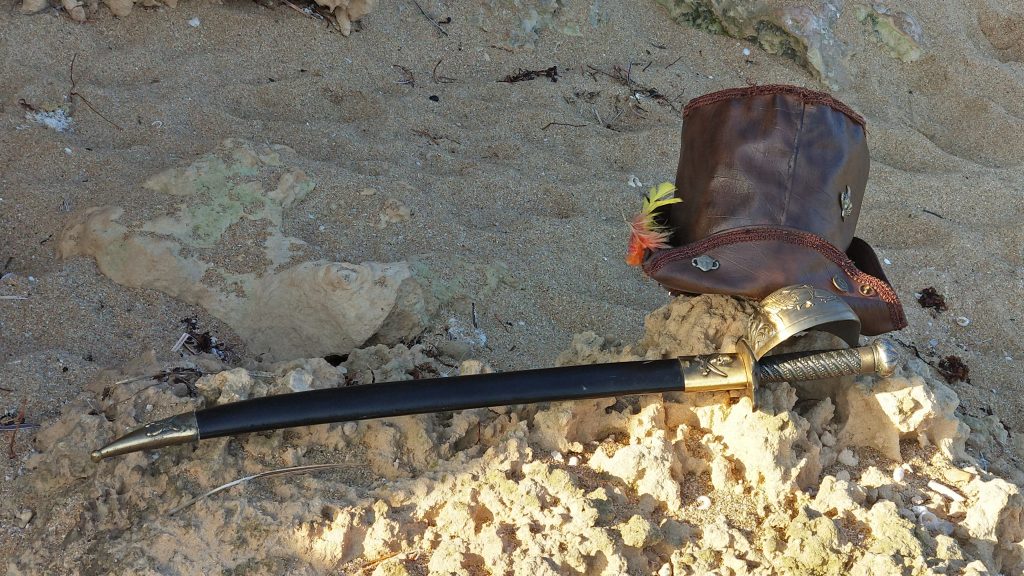
Consider the difference between a poniard and a claymore.
Poniard
- Rigid
- Point at the end
- Length between 150 mm to 300 mm beyond the grip.
- No edges
Claymore
- Rigid
- Point at the end
- Length around 1500 mm, grip is 300 mm.
- Two edges
You may also like
The tactics for how you would use these vary significantly due to range, number of edges (0 or 2), and the setting you are likely to find yourself in battle. If you, a Scots, took your poniard as your main weapon to a conflict with the English army, you would have a glorious but short battle. If you took your claymore, you are more likely to take some English with you.
A longer sword gives you greater range – where you can keep your opponent at a range where you can tag them, long before they may touch you. Closing the distance takes time, which allows you more space to make mental and physical calculations. Additionally the object itself has more mass, and will take longer to shift around, which is offset by the additional range the item gives you. Since speed is likely compromised, it is generally worth increasing your armour. So a large weapon will often be a ranged game with stronger armour. While this will be a common trend, it is not absolute. Personally, I like fighting with my 100 cm rapier (medium length) and bypassing my opponents point, to fight a much closer game with minimal armour.
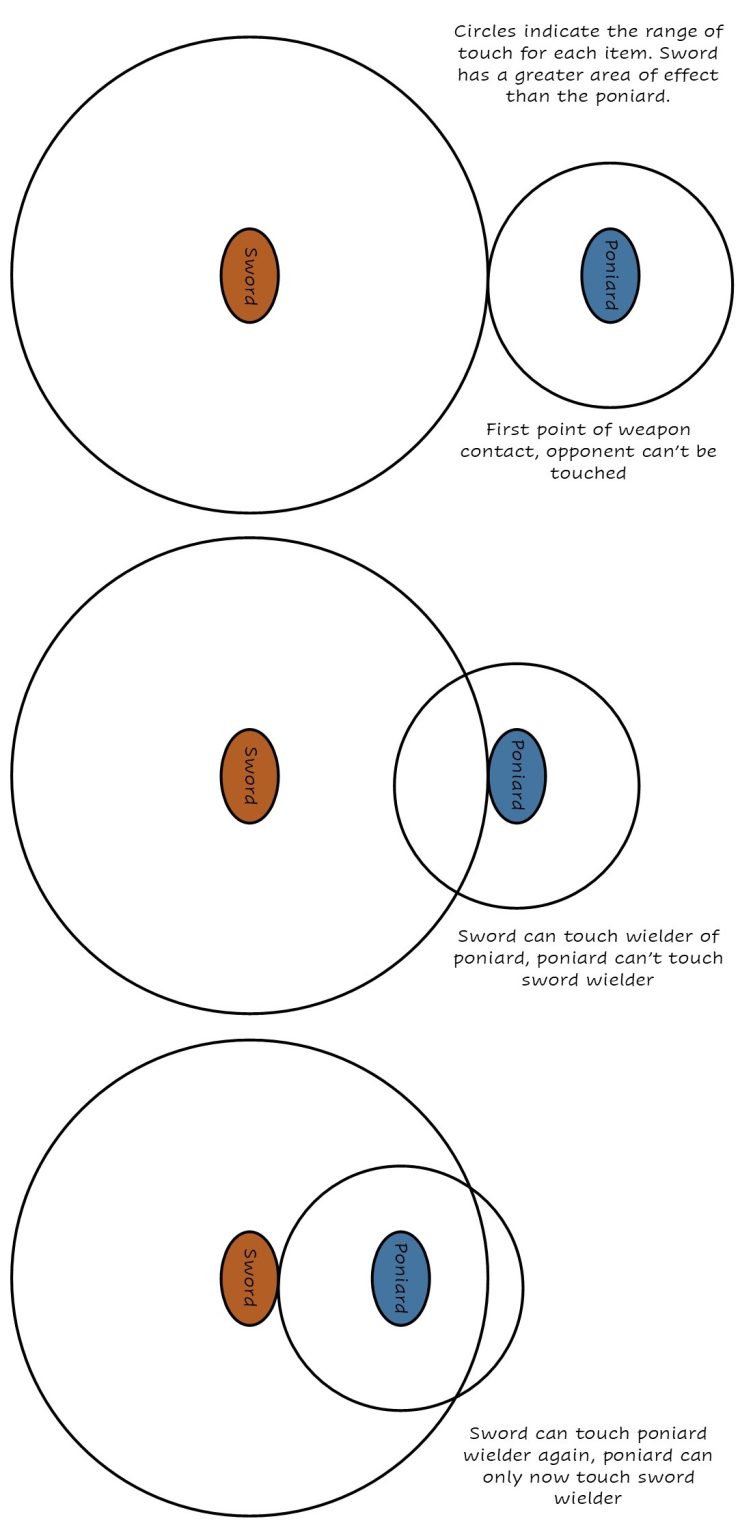
A shorter blade brings the range of attack closer, which increases the speed. Often that is because of less reaction time, less mass in the item and a secondary effect of less armour. A person with a short item against a person with a longer item needs to close the distance, past the circle of first contact for the long item to the short itemed person (where the long item can do damage but the short item can’t), past a distance of risk to the person wielding the short item until the person with the short item can do some kind of response to the person with the long item. The wielder of the long item effectively has two free attacks in this time of closing, and should then be at a distinct disadvantage of speed and range once closed.
Adding an edge to the item allows for missed thrusts (point attacks) to still be useful, as cutting with the side of the item gives a second chance attack. Once you have an edge to your item, you may de-prioritise the thrust attack and start implementing edge attacks, hacking instead of stabbing. For example, you could hack at your opponent, requiring them to block you or perish. You can then orient your sword to follow up with a thrust, or another cut.
Your options to control your opponent has now increased. It is important to recognise that a thrust travels in a relatively straight line, which means that blocking it is a matter or precession. Too early and your opponent varies the location of attack with minimal change in speed; too late and you are hit. A cut travels in an arc, effectively creating a plane of attack. So long as you have your defence intersecting the incoming plane of attack early enough, you can stop your opponents cut, requiring them to vary the attack with a significant speed loss.
Mobility is a factor to consider. A poniard on a chariot is not a good choice for combat against another chariot, but is great against the chariot driver you have just hijacked. Mounted on a horse is a different idea again, where your sword needs to be long enough to reach opponents as you ride by, but not likely to become stuck in your opponent, or get knocked out of your hands upon a speedy contact (hence the curve in sabers). If you are on foot, do you provide a static target, or a moving one? How well do you use voids to ignore your opponent’s device such that you get a free attack, or do you use a shield to block freeing up your sword, or is your sword your primary defence? Do you always void to the same location? In which case your opponent will start to attack the place you are going instead of where you have been.
Take a look at your chosen weapon and armour. Consider the weapons properties. What are its properties in regards to reach, speed, point and edge? What range is optimal for you to fight in, and how can you adjust that? Is the weapon symmetrical, or does it change if you rotate it? What are the strengths and weaknesses of your armour in combat? What mobility do you use, and how will that affect all of the above? Now consider your opponent. What weapon do they use and what are its properties? What are the strengths and weaknesses of their armour and their mobility? What advantages can you find in the meeting of yours and theirs?
Now take a look at what hand they hold their items in. Is it the default biggest item in their right hand, or is it in their left hand? Do they hold their grip well, or are they clutching or grasping their item? A confident leftie against a confident rightie has a distinct advantage, in that left handed people are well experienced fighting right handed people, while righties are not as practiced fighting lefties due to the ratio of left and right handed people. Perhaps it is worth fighting the leftie with your left, as their lack of practice against lefties may be worse than your lower skill with your left (if you are right handed).
These are the considerations that I have upon selecting my devices and walking into combat with my opponent. These thoughts run through my mind before I close range and before “lay on” are called.